Join us on an 8-day, thrilling, and adventurous white-water river rafting expedition in Nepal. If you are looking for a multiday river rafting package, then the Sunkoshi River rafting is the best choice.
The Sunkoshi River is the longest in Nepal and is recognized as one of the top 10 rivers in the world for a multi-day river rafting expedition. On the Sunkoshi River rafting, you will experience Class III to Class V rapids, big waves, and calm floats.
The Sunkoshi River rafting is 270 km long, which you will complete in 8 days. Starting from Dolalghat, you will raft all the way through narrow gorges and beautiful river valleys to Chatara (end point). This river is also known for intermediate kayaking.
In between put-in and put-out places, you will spend nights in Pachuwarghat, Chainpur, Jhagare, Raighat, Rasuwaghat, Waterfall Camp, and Tribenu. Our support team will take care of camping and cooking.
It is a camping trip. So, you will spend nights at riversides in camps. We provide full camping equipment and all rafting gear. The daytime is spent rafting and exploring, and at night we will enjoy warm food and a bonfire under skies full of stars.
The Sunkoshi River
Located in the eastern region of Nepal, the Sunkoshi is the longest river. This river originates in Tibet and flows from north to south, draining through valleys, forests, and villages.
The Sunkoshi River runs eastwards almost parallel to the Mahabharat mountain range. The meaning of the Sunkoshi River is the River of Gold.
Things to know before doing Sunkoshi River rafting for 8 days
Anyone planning to do the Sunkoshi River rafting for 8 days should know the following things:
About the Sunkoshi River
Meaning: “River of Gold” (named after the golden sands and its beauty)
Location: Eastern Nepal, starting from Dolalghat (near Kathmandu) and ending at Chatara (Terai plains)
Length: About 270 km (Nepal’s longest commercial rafting trip)
Duration: Typically 8–10 days on the water (our Sunkoshi River rafting itinerary is 8 days long)
Rafting route: Multi-day expedition through remote valleys, villages, and forested gorges
Difficulty level
Grade: Class III to V rapids (ranging from moderate to highly challenging)
Experience required: Not beginner-friendly (previous rafting experience, like Trishuli or Seti, is recommended)
Physical demand: Endurance, good fitness, teamwork, and long hours of paddling are required
Best time for Sunkoshi River Rafting
Recommended seasons: Autumn (September to November) and spring (March to May)
Avoid: Monsoon (June to August) and winter (December to February)
Famous Rapids
Each rapid is different, ranging from big waves to technical currents.
- Meat Grinder
- Dead Man’s Eddy
- Rhino Rock
- High Anxiety
- Roller Coaster
Sunkoshi River rafting route/itinerary
You will begin the journey with a three-hour drive from Kathmandu to Dolalghat. Upon reaching the put-in point, you will meet your rafting team and join a briefing session.
During the briefing, you will learn about the Sunkoshi River's conditions, rapids, safety, paddling techniques, and other essential information. Then you will get fitted with gear and begin rafting to Pachuwarghat.
The rapid ranges between Class II and III and goes through scenic valleys. You will spend the night camping on the sandy river beach. The next day (day 2), you will raft from Pachuwarghat to Chainpur.
You will paddle through lush hills and small villages. In the midsection, the rapids get exciting (Meat Grinder). Enjoy riverside camping at Chainpur. From Chainpur, you will raft to Jhagare.
On this day, you will experience a mix of calm and splashy rapids while crossing beautiful gorges and sandy beaches. On the fourth day of rafting from Jhagare to Raighat, you will encounter bigger waves and powerful rapids (High Anxiety and Hakapur) as the river widens.
In Raighat, you will spend the night at a stunning riverside spot. Rasuwaghat is your next destination. Between Raighat and Rasuwaghat, you will enjoy another big raid day (Class III - V).
The route offers breathtaking views of hills covered with lush greenery and remote villages. After Rasuwaghat, you will raft to Waterfall Camp. On the way, you will paddle through bouncy rapids and calm sections that are perfect for swimming.
We will also take you on a short hike to a gorgeous hidden waterfall. Continuing the journey, you will raft to Tribeni, which is the confluence of the Arun & Tamur rivers.
On the last day of the trip, you will raft from Tribeni to Chatara. Chatara is the ending point of our 8-day rafting expedition. We will drive from here to Kathmandu.
Safety guidelines for Sunkoshi River rafting
Follow the safety guidelines below during Sunkoshi River rafting:
Choose a licensed and experienced rafting operator team:
For your safety, we recommend doing Sunkoshi River rafting with a company that is registered with the Nepal Association of Rafting Agencies (NARA) and the Nepal Tourism Board.
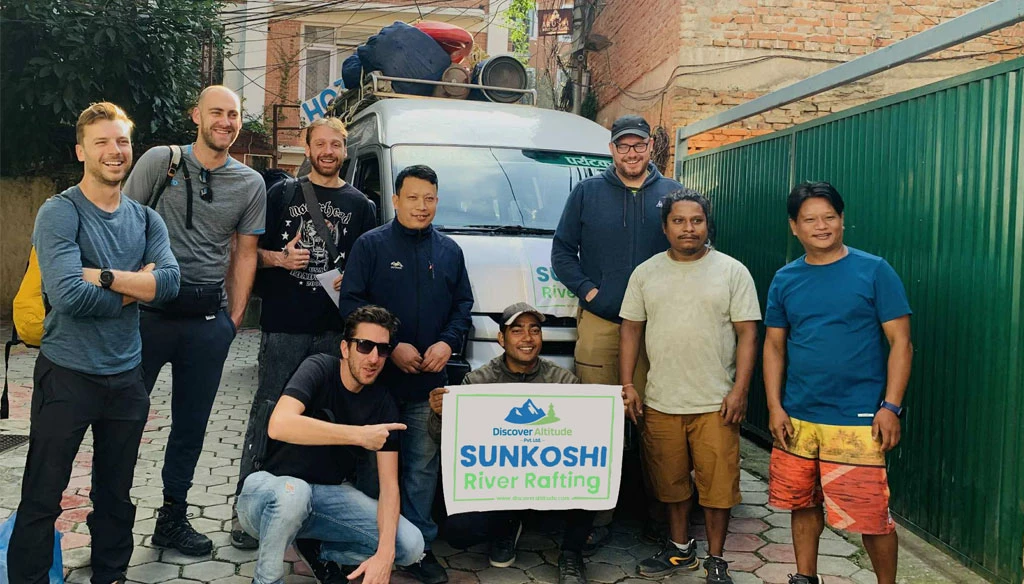
For instance, we, Discover Altitude, are an authorized Nepali travel company that can organize all kinds of adventure programs for foreigners in Nepal. For the Sunkoshi River rafting 8 days, we work with a very experienced and NARA-registered company that specializes in rafting.
Rafting with us ensures your safety. We provide high-quality rafting gear, a professional team of rafters who are aware of rapids on the Sunkoshi River, support staff for camping, and emergency communication devices.
Pay attention to safety guidelines shared by your team:
Before you begin rafting, your team will explain the river, its conditions, rafting gear, how to use them, safety measures, and other helpful information.
Listen carefully and do not hesitate to question if you do not understand anything. Your guides will explain to you the following things:
- Paddling command
- Team coordination
- Rescue positions
- Throw-bag recover
- How to reach if you fall overboard
- Signals and emergency proc
Use safety gear properly:
Always check your helmet, life jacket (PDF), wetsuit, river shoes, gloves, etc, are in the right place. You have to wear quick-dry clothes and avoid cotton clothes.
Paddle as a tam:
Team coordination is most important for safety and the best rafting experience. Rafting demands synchronized paddling, especially on big waves and long rapids.
Follow your guide's commands actively, such as forward, back, get down, etc. Likewise, maintain balance when the raft hits a wave.
What to do if you fall into the water during rafting?
- Rafters falling into the water during rafting. It is common. So, try not to panic and stay calm. We understand it is easier said than done, but it's what you have to do. Float on your back with feet pointing downstream and head up.
- If possible, hold your paddle. However, do not try to hold on to it if it jeopardizes your safety.
- Do not stand up in fast water. It can lead to foot entrapment.
- Wait for your guide's help. Try to swim towards the raft or riverbank.
Camp safety:
Our support team will take care of camp safety. They know where to establish tents and other gear. Still, for your information, these are things you should do to ensure your safety during camping:
- Set up the tents well above the waterline
- Stay away from loose rocks
- Use headlamps at night
- Keep dry clothes and valuable things in dry bags
- Follow hygiene and practice waste management
Emergency preparedness
Our rafting guides carry:
- First aid kit
- Satellite phone
- Repair kit for rafts
- Carabiners, ropes, and rescue line
Each participant should also carry basic first aid.
Season awareness:
Know the best seasons and seasons to avoid. It will help you pick the right time for rafting and also ensure your satisfaction and safety.
Fitness and health:
Sunkoshi River rafting is not easy. It is a physically demanding activity. You have to be fit, able to swim, and be comfortable in moving water.
If you have any medical condition that can be affected by Sunkoshi River rafting, consult your doctor and also inform us.
Keep yourself hydrated, well-rested, and well-fed during the 8 days journey.
How difficult is Sunkoshi River rafting in Nepal?
The Sunkoshi River rafting is a bit more difficult than other river raftings in Nepal. Things like water volume, section of the river, and your previous rafting experience ultimately determine whether the Sunkoshi River rafting is tough or not.
Below, we have shared different factors that determine the Sunkoshi River rafting difficulty level:
- Rapid grade: The Sunkoshi River features Class III to Class V rapids. The rapid changes from one season to another. You can experience rapids such as Meat Grinder, Rhino Rock, Dead Man's Eddy, and High Anxiety on this river.
- Length and remoteness: The Sunkoshi River rafting is 270 km long. It starts from Dolalghat and ends in Chatara. The trip is 8 days long, and you will raft every day. Only a few sections of the river follow roads, and most of the river is in remote terrain.
- Seasonal variation: Depending on the season, the water in the Sunkoshi River can change drastically. The water flow is highest in autumn (post-monsoon). Therefore, the rapids are also powerful and dangerous in autumn. In spring and winter, the water level remains low, so the rapids are easy to manage.
- Technical rapids/obstacles: The Sunkoshi River has rapids with drops, waves, holes, strong current, and eddies. Before certain rapids, scouting is sometimes required.
- Physical demand and risks: You will raft for several hours each day during the Sunkoshi River rafting. Therefore, physical and mental demands are high. Similarly, risks include being thrown off the raft, capsizing, getting caught in a strong current, etc. So, rafters have to use safety gear and strictly follow the guide's instructions.
Is Sunkoshi River rafting suitable for you?
The Sunkoshi River rafting may not be for everyone. Ask yourself the questions below to know whether this rafting program is suitable for you or not.
- Do you have previous rafting experience, especially on class III/IV rapids?
- Have you done multi-day rafting before?
- Are you okay being physically challenged for several hours each day?
- Are you comfortable with getting wet and cold for several hours daily during rafting?
- Which is better for you- moderate or high rapid?
- Are you ready to spend eight days enjoying remote, riverside camping?
We also have one-day thrilling white-water rafting programs in Nepal if your vacation does not allow a multi-day river rafting trip to Nepal. Nepal also has some of the finest one-day white-water rafting rivers.
When is the best time to do the Sunkoshi River rafting?
The best time for the Sunkoshi River rafting is pre-monsoon (spring) and post-monsoon (autumn). The river is in the best conditions in these two seasons for a thrilling white-water rafting adventure.
Autumn (September to November):
If we have to pick one season for the finest Sunkoshi River rafting experience, we will pick the autumn season. It is post-monsoon time, so the river has a steady and powerful flow.
You can experience IV and V rapids. The weather is warm and clear. There can be occasional rainfall in September. You will raft during the daytime and camp by the riverside. The scenery is also lush and green.
- Water level: Medium to high - thrilling but manageable
- Rapids: Challenging and exciting - up to V (not extreme like during peak monsoon)
Spring (March to June):
Spring is the second-best option to do the Sunkoshi River rafting for 8 days. As the snow begins to melt with the beginning of spring, the water flow is slightly elevated. It makes the rapids fun and continuous, but not extreme like autumn.
The weather is pleasant and warm, so you will enjoy camping. Warmer daytime and slightly chilly evenings will make bonfires incredible. Likewise, there are also fewer rafters in the spring, so you will have a peaceful experience.
- Water level: Media (perfect for rafters looking for exciting but not huge waves)
- Rapids: Moderate
Monsoon (June to August): Avoid this season
In the monsoon, the Sunkoshi River becomes too dangerous for rafting. Massive floors, strong currents, debris, and limited visibility make rafting risky even for highly experienced rafters.
Winter (December to February): Too low water level and cold
Rafting in winter is no fun. Water levels are too low, and the cold climate becomes unbearable.
What to pack for the Sunkoshi River rafting?
We have made a list of things you will need for the Sunkoshi River rafting:
*We provide camping essentials and rafting gear.
For rafting:
- Quick-dry clothes (avoid cotton)
- Wetsuit or dry top (seasonal)
- Secure river sandals or neoprene shoes
- Sunglasses with a strap, sunscreen, and lip balm
- Refillable water bottle
For camping:
- Lightweight towel and toiletries
- Warm layers for the night
- Flashlight or headlamp
- Personal medicines and first-aid essentials
- Dry bags for electronics and clothes
General things:
- Normal clothes and footwear when not rafting
- Comfortable backpack
- SPF (wear it all the time and reapply to avoid sunburns)
- Moisturizer and lip balm
- Oil your hair to keep it in its best condition
- A few warm clothes and socks if the climate gets cold at night
Why choose Discover Altitude as your Sunkoshi River rafting partner?
With Discover Altitude, you will raft with the industry's best rafters. We work with professional rafters who have many years of expertise and can lead you with safety and confidence.
You will get the most affordable Sunkoshi River rafting cost and the best service with us. We have been organizing Sunkoshi River rafting for several years for our guests from around the world.
With us, you are not only signing up for a rafting trip but also joining a passionate community that values safety, comfort, and authenticity. Our certified rafting guides and kayakers accompany you during the journey, ensuring your safety and satisfaction.
You will get top-quality international standard rafting gear, a nice camping setup, and hygienic meals during the Sunkoshi River rafting 8 days. From the start to the end of the trip, you will get full support from our team.
Bookings are open for Sunkoshi River rafting 2026 departures. If you have any questions regarding our Sunkoshi River rafting package, feel free to contact us.
- Raft with certified, professional rafters and kayakers
- Reliable logistics team
- 24/7 support
- Genuine Sunkoshi River rafting price
- Customizable itinerary
- Local insights
- Top-quality international-standard rafting gear
- Hygienic, delicious meals
- Comfortable camping setup